

In today’s technology-driven business environment, reliable IT systems are essential for productivity, security and business continuity. From managing cloud infrastructure and protecting business data to supporting employees and maintaining critical applications, organisations depend on technology to operate efficiently.
However, businesses must decide how best to manage their IT requirements. Two common approaches are Managed IT Services and Break-Fix IT Support. Each model offers different advantages, costs and levels of service, making it important to understand which approach aligns with your organisation’s needs.
What Are Managed IT Services?
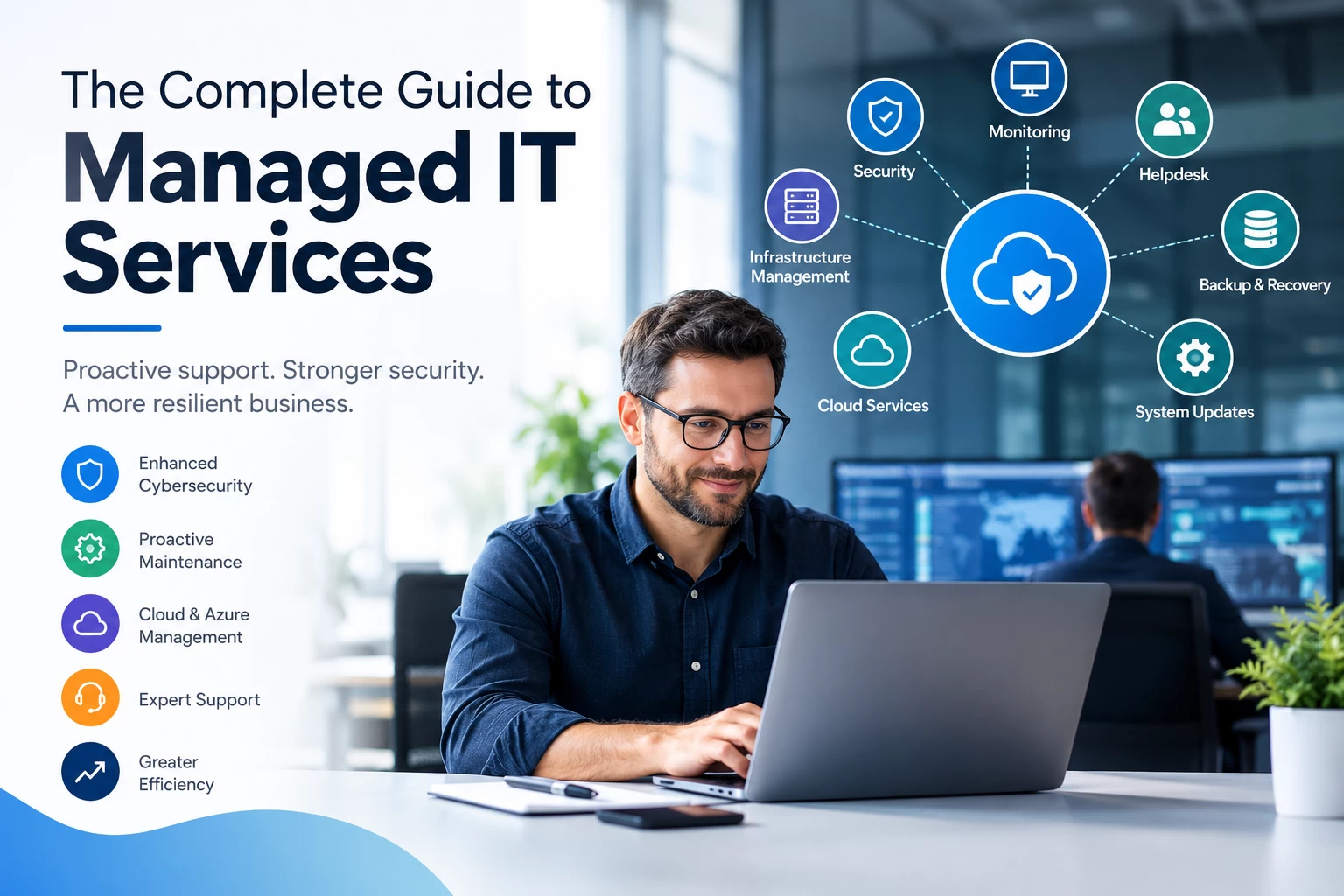
Managed IT services involve outsourcing some or all of an organisation’s IT operations to a specialist service provider under an ongoing agreement. Instead of waiting for technology problems to occur, the provider proactively monitors, maintains and supports IT systems to help minimise disruptions.
Managed IT services can include:
- Proactive monitoring and maintenance of IT infrastructure.
- Helpdesk and end-user technical support.
- Cybersecurity monitoring and threat prevention.
- Microsoft 365 and Azure cloud management.
- Backup, disaster recovery and business continuity planning.
- Network, server and endpoint management.
- Software updates, patch management and IT asset management.
Most managed service agreements use a recurring monthly fee, providing greater predictability for IT budgeting and ongoing access to technical expertise.
What Is Break-Fix IT Support?
Break-fix IT support follows a reactive approach. Businesses contact an IT technician or service provider when a system fails, an application stops working or a technical issue requires attention.
The provider diagnoses the problem, carries out the necessary repairs and charges for the work performed, often based on hourly rates or individual service calls.
Typical break-fix services include:
- Troubleshooting hardware and software problems.
- Repairing failed computers, servers and network equipment.
- Resolving connectivity and application issues.
- Recovering access to systems after technical failures.
- Replacing faulty components and restoring services.
This model can be suitable for organisations with limited IT requirements or those that need occasional technical assistance without committing to an ongoing service agreement.
Managed IT Services vs Break-Fix: Key Differences
| Feature | Managed IT Services | Break-Fix Support |
|---|---|---|
| Service approach | Proactive and preventative | Reactive and corrective |
| Pricing model | Usually a recurring fee | Pay per incident or service |
| System monitoring | Ongoing, depending on the agreement | Generally limited to requested work |
| Maintenance | Scheduled and continuous | Usually performed when required |
| Cybersecurity | Can include ongoing security management | Often requires separate arrangements |
| Budget planning | More predictable | Can fluctuate significantly |
| Business continuity | Can include planned recovery measures | Recovery typically follows an incident |
| Strategic IT planning | May be included | Usually limited or separately charged |
The actual level of service depends on the provider and contract. Businesses should review inclusions, exclusions, response times and additional charges before making a decision.
The Benefits of Managed IT Services
1. Proactive Monitoring and Reduced Downtime
One of the main advantages of managed IT services is the ability to identify potential problems before they cause significant disruption.
Monitoring tools can detect performance issues, storage capacity constraints, failed backups and other warning signs. Addressing these issues early can reduce downtime and help employees remain productive.
2. Predictable IT Costs
A recurring service agreement can make IT expenditure easier to forecast and manage. Businesses can plan their technology budgets without relying entirely on unpredictable repair bills.
However, organisations should confirm whether projects, after-hours support, hardware replacements, software licences and major remediation work are included in the agreed fee.
3. Improved Cybersecurity
Cyber threats continue to evolve, making ongoing security management increasingly important.
Managed IT providers may offer security monitoring, endpoint protection, vulnerability management, patching, identity management and backup oversight. These services can help businesses strengthen their security posture and reduce exposure to common threats.
A managed service agreement does not automatically guarantee security. Businesses should confirm which controls are implemented, how incidents are handled and which responsibilities remain with the organisation.
4. Access to Specialist Expertise
Maintaining an experienced internal IT team can be expensive, particularly for small and medium-sized businesses.
Managed IT services provide access to technical specialists across areas such as cloud computing, networking, Microsoft 365, cybersecurity and infrastructure management without requiring every skill set to be employed internally.
5. Scalability and Business Growth
As organisations grow, their IT requirements often become more complex. Managed services can help businesses add users, deploy new systems, migrate workloads and expand cloud resources as needed.
This flexibility allows IT support to evolve alongside business operations.
The Challenges of Managed IT Services
Although managed IT services offer significant advantages, businesses should also consider potential challenges.
Ongoing service costs: Monthly fees continue regardless of how frequently support is required. Businesses with very limited IT needs may find a full managed service agreement less economical.
Dependence on the provider: Outsourcing critical IT functions creates a reliance on the provider’s skills, service quality and responsiveness. Clear service-level agreements and documented exit arrangements are important.
Less direct control: Some operational decisions may be handled by the service provider. Businesses should establish approval processes, access permissions and clear responsibilities.
Service scope limitations: Not every agreement includes unlimited support, cybersecurity incident response, application development or major infrastructure projects. Unclear inclusions can lead to unexpected charges.
Selecting a provider with transparent pricing, appropriate technical expertise and clearly defined service commitments can help address these challenges.
The Benefits of Break-Fix IT Support
1. Pay Only When Support Is Needed
Break-fix support can be cost-effective for businesses that experience very few technical issues and have straightforward IT environments.
Rather than paying a fixed monthly fee, organisations pay when assistance is required.
2. Flexibility in Provider Selection
Businesses can engage different specialists for particular issues, projects or hardware repairs. This can be useful when specialist expertise is required occasionally rather than continuously.
3. No Long-Term Managed Service Commitment
Depending on the arrangement, break-fix support can be accessed without entering into an ongoing managed service contract. This may appeal to startups or organisations with temporary support requirements.
The Challenges of Break-Fix IT Support
1. Unexpected Expenses
A major server failure, cybersecurity incident or network outage can result in substantial repair and recovery costs. Without an ongoing service agreement, businesses may have limited visibility over future IT expenditure.
2. Increased Risk of Downtime
Because support is generally requested after a problem occurs, underlying issues may remain undetected until they affect business operations.
Extended downtime can affect employee productivity, customer service, revenue and reputation.
3. Limited Preventative Maintenance
Regular patching, performance monitoring, backup testing and security reviews may not be performed consistently unless separately arranged.
This can allow small technical issues to develop into more serious incidents.
4. Uncertain Response Times
Availability may depend on the technician’s workload, the severity of the issue and the terms of the service arrangement. Businesses requiring guaranteed response times should confirm these commitments in writing.
Which IT Support Model Is Right for Your Business?
The right approach depends on your organisation’s size, technology environment, risk exposure and internal IT capabilities.
Managed IT services may be more suitable if your business:
- Relies on technology for daily operations.
- Requires ongoing cybersecurity and system monitoring.
- Needs predictable IT expenditure.
- Operates across multiple sites or supports remote employees.
- Uses Microsoft 365, Azure or other business-critical cloud platforms.
- Needs reliable backup, recovery and business continuity arrangements.
Break-fix support may be suitable if your business:
- Has a small and relatively simple IT environment.
- Experiences technical issues infrequently.
- Has employees capable of handling routine IT administration.
- Can tolerate occasional delays in resolving non-critical issues.
- Needs occasional specialist assistance rather than continuous support.
Some organisations choose a hybrid model, maintaining internal IT staff or using break-fix support for selected tasks while outsourcing cybersecurity, cloud management, backup monitoring or other critical functions.
How to Choose a Reliable Managed IT Service Provider
Before entering into a managed service agreement, consider the following factors:
- Service-level agreements: Confirm response targets, escalation procedures, service availability and support hours.
- Cybersecurity capabilities: Understand how the provider manages identity security, endpoint protection, patching, monitoring and incident response.
- Backup and recovery: Review backup frequency, retention, recovery objectives and testing procedures.
- Pricing transparency: Identify included services, exclusions, additional charges and contract renewal conditions.
- Scalability: Ensure the service can support future growth, new locations and changing technology requirements.
- Reporting and accountability: Request regular reporting on service performance, security issues, recurring incidents and improvement opportunities.
- Exit arrangements: Confirm how documentation, credentials, data and administrative access will be transferred if the relationship ends.
A good provider should act as a technology partner, helping the business manage risk, improve operational efficiency and make informed technology decisions.
Conclusion
Both managed IT services and break-fix support have a place in modern business IT management. Break-fix can provide flexibility and lower ongoing costs for organisations with limited support needs. Managed IT services, on the other hand, offer a more proactive approach to system maintenance, cybersecurity, cost planning and business continuity.
The decision should not be based on service fees alone. Businesses should also consider the financial and operational impact of downtime, security incidents, lost productivity and unexpected technology failures.
For organisations that depend on reliable IT systems, a proactive and well-governed support model can help reduce operational risk and create a stronger foundation for growth.
The key is to choose an IT support strategy that aligns with your business objectives, risk tolerance and long-term technology needs.

